Private Label vs Wholesale: Where Should You Start?
Compare private label and wholesale on Amazon: brand ownership, sourcing, launch costs and daily operations. Choose a model that fits your next move.
You can start selling on Amazon without starting a brand. You can also build a brand that eventually sells well beyond Amazon. Those are different businesses, and choosing between them changes what you buy, what you spend and what you need to learn.
Private label means selling a product under your own brand. Wholesale, in this guide, means buying existing branded products from suppliers to resell. It does not mean selling bulk orders to businesses through Amazon Business. Here is how to decide which route deserves your attention first.
Start with the business you want to run
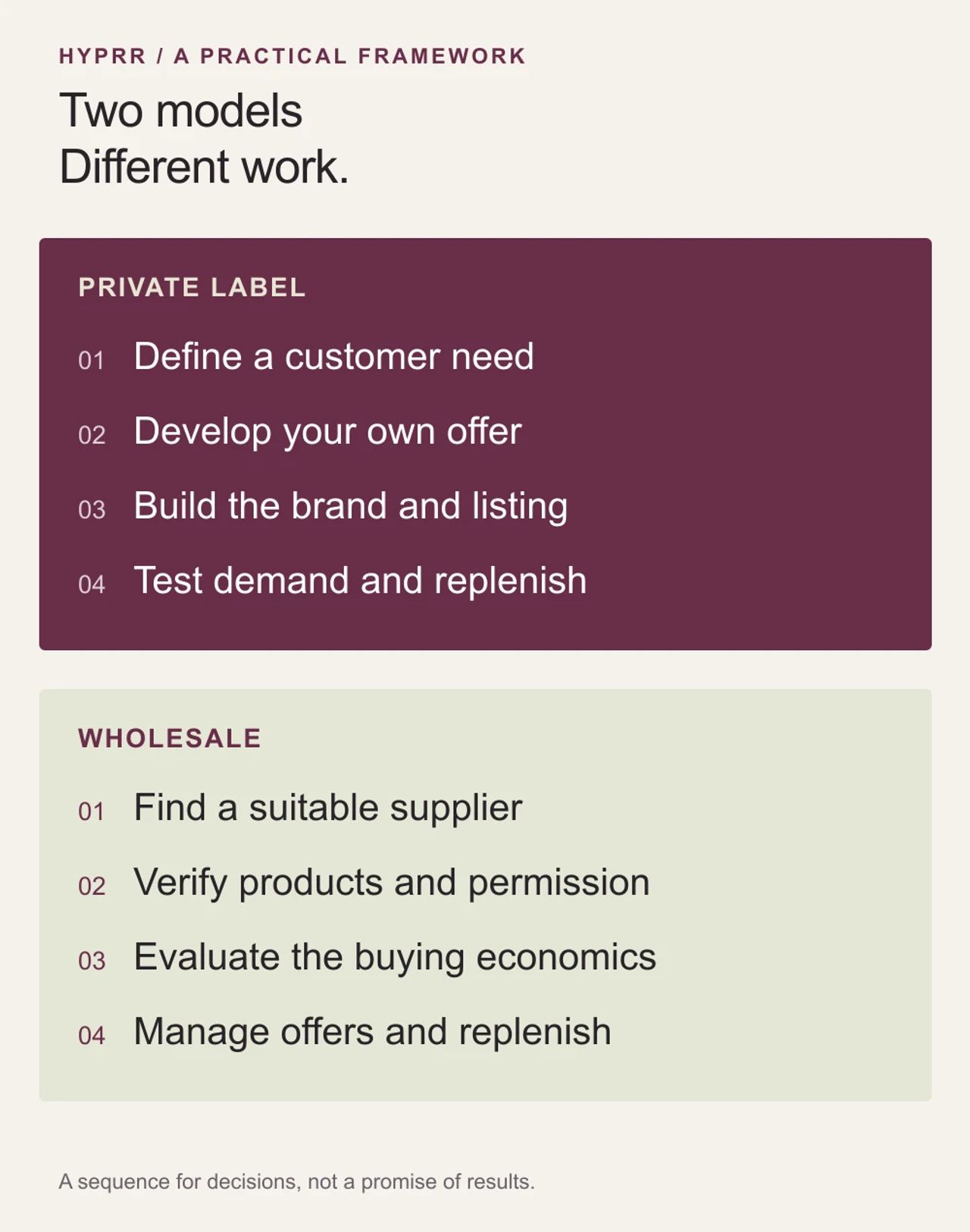
If you want to shape the product, packaging and customer experience, private label gives you more room to do that. You also take responsibility for creating an offer people have a reason to choose. A logo on a familiar product is a starting point, not a complete proposition.
Wholesale puts more of your attention on supplier relationships, buying decisions and repeatable operations. You assess an existing product and the conditions under which you can sell it. Being able to buy stock does not automatically establish permission to sell every brand, product or category on Amazon.
Amazon's private label guide explains the own-brand model. Its reselling guidance covers the responsibilities involved in selling products sourced from others.
Compare the costs before comparing the upside
For a private label launch, build a budget around samples, product development where needed, packaging, inspection, stock, freight, content and an advertising test. Keep a separate allowance for delays and the next order. Spending everything on the first production run leaves little room to learn.
For wholesale, work from a specific supplier quote and product, rather than a broad claim about average margins. Include preparation, inbound transport, selling fees, fulfillment, storage, returns and the impact of price changes. Decide how long you can afford to hold the stock.
Neither model is automatically cheaper or more profitable. The useful question is whether a particular order still makes sense when sales are slower or costs are higher than your first estimate.
What changes after the first order?
With private label, the early work is often about finding the connection between product, message and audience. Does the main image explain what is being sold? Do the words answer the buyer's questions? Are ads bringing relevant visits? Learn from that before adding several variations.
With wholesale, the daily questions are more operational. Is the offer active? Does the current selling price still meet your buying criteria? Is replenishment reliable? Are the documents and account records organised? A product that looked attractive last month may not justify another order today.
Fulfillment is another decision, separate from the business model. Amazon FBA can handle eligible inventory fulfillment and associated customer service and returns. It does not replace your responsibility for sourcing, forecasting or business economics.
Can one product become a brand?
Yes, but a larger catalogue is not the same thing as a stronger brand. Start with a clear customer and a useful product. Add a complementary item when it serves the same customer, addresses a related need and has its own commercial case.
That is where a direct-to-consumer store can become useful: it gives you another place to explain the range and serve people who choose to shop with you directly. It also creates work in customer acquisition, fulfillment and retention. Treat DTC as a channel to validate, not an automatic next step.
A practical starting checklist
- Choose the responsibility you want: developing a brand or operating a resale business.
- Set the amount you can commit while keeping a working-capital reserve.
- Evaluate one concrete product or supplier opportunity in detail.
- Identify the documents, product requirements and operational gaps before placing an order.
- Set a review date and a clear reason to proceed, revise or stop.
Where Hyprr helps
Our private label service connects product research, sourcing, identity, listings and launch planning. Our wholesale management service focuses on supplier evaluation, buying decisions and the work of running the account. The right starting point depends on the opportunity and what you want to own.
Talk to Hyprr about your starting point. Bring the idea, a supplier list or the products you already sell. We can help turn that into a defined next step.
Visuals are illustrative brand concepts, not client work or a product endorsement. Platform resources checked September 2026; confirm current requirements before acting.