Wholesale / Amazon + Walmart

We run wholesale operations on Amazon and Walmart.

Sourcing from authorised distributors, purchase orders you approve, and the daily work of keeping those lines selling.

MANAGED OPERATIONSAUTHORISED DISTRIBUTORSAMAZONWALMART
A buying catalogue showing six supplier lines with landed cost, fees, margin and a buy or no decision on each
Representative buying catalogue. Figures illustrate the model, not a client account.

How wholesale actually works

Every brand sells its products through more than one route. Some sell direct to Amazon. Some sell through distributors. Most also sell on their own website. Those routes do not cover every listing, every region or every moment of demand, and that gap is where a wholesale seller operates: buying genuine stock through an approved channel and selling it where the brand is not already serving the customer well.

What does an Amazon wholesale agency do?

It runs the wholesale operation on your behalf: supplier approval and terms, landed-cost modelling on every line, purchase orders raised for your written approval, listings, pricing, buy box and replenishment — under accounts and supplier relationships that stay in your name.

Starting from zero, or already operating.

01 — STARTING FROM ZERO

You have capital and no operation.

We open supplier accounts in your name, build the catalogue, model every line and run it.

  • Seller account and supplier applications
  • Catalogue built and modelled to landed cost
  • First purchase orders, sized deliberately small
  • The daily operation from day one
See the first year →
02 — ALREADY OPERATING

You have suppliers and sales.

We take over the daily work, tighten buying and replenishment, and grow the catalogue.

  • Catalogue and margin review, line by line
  • Buying and replenishment discipline
  • Buy box, pricing and account health
  • New suppliers and new lines
See the operating cycle →

Authorised distributors only.

We buy from brands and their authorised distributors. That means brand approval, real distributor terms, and invoices issued to you. It is slower to set up than buying wherever stock is cheapest, and it is the reason accounts survive their second year.

Brand approvalThe brand, or its named distributor, knows the stock is being sold and approved the channel — including ungating where a category needs it.
Distributor termsReal trade accounts with real terms, opened in your name — not gray-market stock from wherever it was cheapest this week.
Invoices in your nameEvery invoice is issued to you. When Amazon asks for proof of supply, you have it, and it is yours.
Cartons stacked and shrink-wrapped on pallets in a distribution warehouse

Every line is modelled before it is bought.

Every line is modelled to landed cost before it is bought. Most fail. You get the sheet that shows why, and we do not buy them.

Nothing is ordered without your approval, in writing. See a sample buying decision →

BUYING DECISION · LINE 04124 SEP
Landed unit cost11.40
Marketplace fees6.85
Competing offers on the listing14
ROI against a 20% floor4.8% · DO NOT BUY

The operating cycle

A loop rather than a line, because it repeats. This is what is included every month.
Suppliers and buyingApplications, terms, landed-cost models and purchase orders for your approval
Catalogue and pricingListings, offers, buy box share and repricing rules
Inventory and replenishmentStock cover, reorder timing, prep and shipments, stranded stock
Account and reportingCases, account health, and the monthly report — margin by line
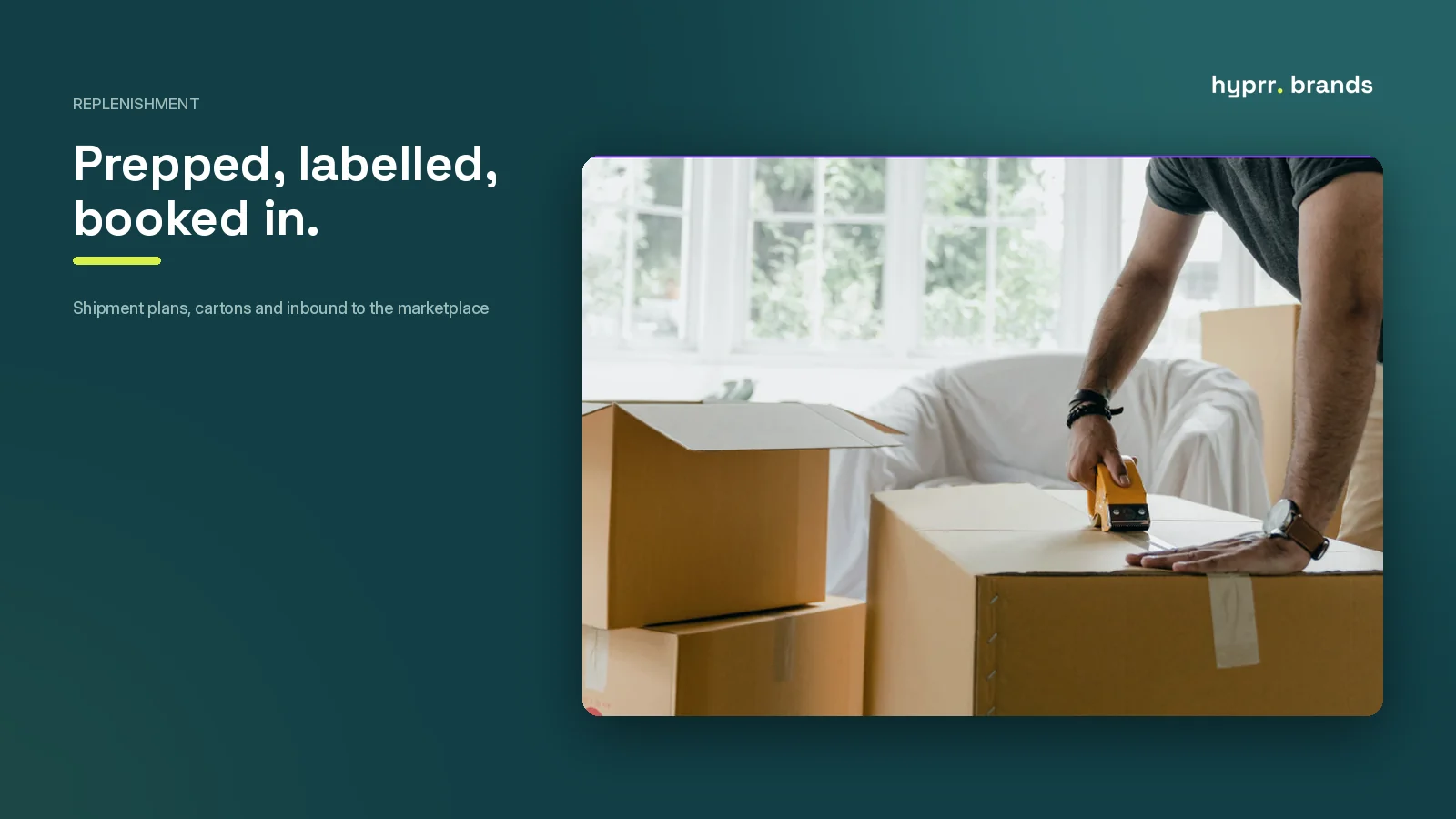
A carton being taped and labelled ready for a marketplace shipment

What the first year looks like

WEEKS 1–4Set upAccounts, supplier applications, catalogue modelling.
DAY 60–90First purchase orderOnce lines clear the margin floor.
MONTHS 3–6RhythmReorder rhythm, buy box share, the first lines that repeat.
MONTHS 6–12CompoundMore suppliers, more lines, and Walmart alongside Amazon.

This is a business that compounds. It is not fast, and anyone describing it as fast is selling something else.

To your budget and your goals.

How far this goes depends on the capital you want working and what you want the business to be. We size that with you on the first call rather than publishing a plan that fits nobody.

More linesFrom suppliers already open
More suppliersNew applications, new categories
WalmartThe same catalogue on a second marketplace
Your sizing →We size it with you on the first call

Run it with us, or build your own team.

Some clients want us running it permanently. Others want an in-house team eventually. We will hire, train and hand over to that team, and document the operation so it survives the handover. Saying so at the start is how you know the work is being done properly rather than kept deliberately opaque.

Yours: the accounts, the stock, the suppliers.

What you ownThe accounts, the stock and the supplier relationships are yours. Suppliers invoice you directly. Nothing is ordered without your written approval.
What we chargeA fixed monthly fee, with a setup project if you are starting from zero. Nothing on your capital and nothing on your ad spend.

How we charge, in full →

Clear answers before the call.

How does Amazon wholesale work?
You buy branded products in bulk from the brand or its authorised distributors, at wholesale prices, and resell them on an existing Amazon listing. There is no brand to build and no listing to create — the work is supplier approval, buying decisions, pricing and replenishment, done well and repeatedly.
Is FBA still profitable?
On lines that clear a margin floor after every fee, yes — and most lines do not. That is why every candidate is modelled to landed cost before a purchase order is raised. Profitability in wholesale comes from the buying discipline, not from the fulfilment method.
Does FBA cost money?
Yes. Amazon charges fulfilment fees per unit, monthly storage fees, and long-term storage fees for stock that sits. Those costs are in our landed-cost model for every line before we recommend buying it, so nothing about the fee structure arrives as a surprise.
How much stock do I need to start?
Less than most people expect. First purchase orders are deliberately small — enough to prove a line sells and reorders, not to fill a warehouse. Volume follows the lines that repeat. We size the starting budget with you on the first call.

Send us a supplier list or a product list.

We will model three lines and tell you what we would do with them.

Book a call20 min, no deck